Indefinite sum
In the calculus of finite differences, the indefinite sum (or antidifference operator), denoted by or , is the linear operator that inverts the forward difference operator That is, if , then satisfies the functional equation



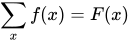


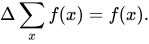
so that applying the forward difference recovers the original function: The operator thus plays the same role for finite differences that the indefinite integral plays for the derivative.
An indefinite sum is not unique: adding any 1-periodic function (satisfying ), the function is also a solution. Therefore, an indefinite sum is unique up to a 1-periodic function instead of up to a constant as the indefinite integral is.


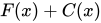

To obtain the unique solution up to a constant , one must impose additional analytic constraints. The Nørlund principal solution is the unique analytic solution that has the minimal possible exponential type (that is, its growth in the imaginary direction on the complex plane is the minimal possible), filtering out any non-constant periodic component. Other methods include higher-order convexity or concavity conditions in real analysis, or using axioms and complex analysis to step back the function's behavior from a neighborhood of infinity in which it behaves polynomially.
For integer arguments, the indefinite sum naturally extends ordinary summation, turning a discrete sum into a continuous function. Many such extensions are well-known special functions.