Cardinality
In mathematics, cardinality is an inherent property of sets, roughly meaning the number of individual objects they contain, which may be infinite. The concept is understood through one-to-one correspondences between sets. That is, if their objects can be paired such that each object has a pair, and no object is paired more than once.
Two sets are said to be equinumerous or have the same cardinality if there exists a one-to-one correspondence between them. Otherwise, under the axiom of choice, one of the two sets must be equinumerous with a strict subset of the other and is said to be strictly smaller than it; the other set is strictly larger. Using this concept, it is possible to show there are different sizes of infinity.
A set is countably infinite if it can be placed in one-to-one correspondence with the set of natural numbers . For example, the set of even numbers and the set of rational numbers are countable. Uncountable sets are those strictly larger than the set of natural numbers. The set of all real numbers and the powerset of the set of natural numbers are proven to be uncountable by so-called diagonal arguments. Cantor's theorem generalizes these arguments to show there is an infinite hierarchy of infinities.
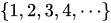

For finite sets, cardinality recovers the usual concept of size as "number of elements." However, it is more often difficult to ascribe "sizes" to infinite sets. A system of cardinal numbers can be developed to extend the role of natural numbers in answering "how many". Most commonly, the Aleph numbers are used, since their definition naturally extends the process of counting, and it can be shown that every infinite set has cardinality equivalent to some Aleph.

The set of natural numbers has cardinality . The question of whether the real numbers have cardinality is known as the continuum hypothesis, which has been shown to be both unprovable and undisprovable in standard set theories such as Zermelo–Fraenkel set theory. Alternative set theories and additional axioms give rise to different properties and have often strange or unintuitive consequences. However, every theory of cardinality using standard logical foundations of mathematics admits Skolem's paradox.


The basic concepts of cardinality go back as early as the 6th century BCE, and there are several close encounters with it throughout history, however, the results were generally dismissed as paradoxical. It is considered to have been first introduced formally to mathematics by Georg Cantor at the turn of the 20th century. Cantor's theory of cardinality was then formalized, popularized, and explored by many influential mathematicians of the time, and has since become a fundamental concept of mathematics.