Derivation (differential algebra)
In mathematics, a derivation is a function on an algebra that generalizes certain features of the derivative operator. Specifically, given an algebra over a ring or a field , a -derivation is a -linear map that satisfies Leibniz's law:



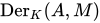
More generally, if is an -bimodule, a -linear map that satisfies the Leibniz law is also called a derivation. The collection of all -derivations of to itself is denoted by . The collection of -derivations of into an -module is denoted by .


Derivations occur in many different contexts in diverse areas of mathematics. The partial derivative with respect to a variable is an -derivation on the algebra of real-valued differentiable functions on . The Lie derivative with respect to a vector field is an -derivation on the algebra of differentiable functions on a differentiable manifold; more generally it is a derivation on the tensor algebra of a manifold. It follows that the adjoint representation of a Lie algebra is a derivation on that algebra. The Pincherle derivative is an example of a derivation in abstract algebra. If the algebra is noncommutative, then the commutator with respect to an element of the algebra defines a linear endomorphism of to itself, which is a derivation over . That is,


![{\displaystyle [FG,N]=[F,N]G+F[G,N]\,,}](./_assets_/eb734a37dd21ce173a46342d1cc64c92/836ced4d428fe3cf3a62a476cc76b476bdeea1cc.svg)
where is the commutator with respect to . An algebra equipped with a distinguished derivation forms a differential algebra, and is itself a significant object of study in areas such as differential Galois theory.
![{\displaystyle [\cdot ,N]}](./_assets_/eb734a37dd21ce173a46342d1cc64c92/d61055f1a5b4d930c261dd9b052d756ed1f8ab21.svg)

