Differentiable function
In mathematical analysis, a real or complex function of a single variable is differentiable if its derivative exists at each point in its domain. For real-valued functions of a real variable, the graph of a differentiable function has a non-vertical tangent line at each interior point in its domain. A differentiable function is locally approximable by a linear function at each interior point, and does not contain any break, angle, or cusp.
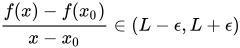
If is an interior point in the domain of a real function , then is said to be differentiable at if there exists an such that for all , there exists a such that for all , . In other words, the graph of has a non-vertical tangent line at the point . is said to be differentiable on a subset if it is differentiable at every point in . is said to be continuously differentiable if its derivative is also a continuous function over the domain of .





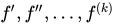
Continuous functions may be nowhere differentiable in their domain, such as the Weierstrass function. Taking successive antiderivatives of such a function allows one to obtain a function that is differentiable only a finite number of times, the finite number being any positive integer. Given a positive integer , is said to be of class if its first derivatives exist and are continuous over the domain of .


For a multivariable function, as shown here, the differentiability of it is something more complex than the existence of the partial derivatives of it.