Differential calculus
| Part of a series of articles about |
| Calculus |
|---|
In mathematics, differential calculus is a subfield of calculus that studies the rates at which quantities change.
The primary objects of study in differential calculus are the derivative of a function, related notions such as the differential, and their applications. The derivative of a function at a chosen input equals the instantaneous rate of change of the function at that input. The process of finding a derivative is called differentiation. Geometrically, the derivative at a point is the slope of the tangent line to the graph of the function at that point, provided that the derivative exists and is defined at that point. For a real-valued function of a single real variable, the derivative of a function at a point generally determines the best linear approximation to the function at that point.
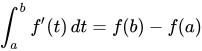
Differential calculus is one of the two traditional divisions of calculus, the other being integral calculus—the study of accumulation or area beneath a curve.Differential calculus and integral calculus are connected by the fundamental theorem of calculus, which states that differentiation and integration are inverse processes in a precise sense.
Differentiation has applications in nearly all quantitative disciplines. In physics, the derivative of the position of a moving body with respect to time is the velocity of the body, and the derivative of velocity with respect to time is acceleration. The derivative of momentum with respect to time gives force in Newton's second law of motion. The reaction rate of a chemical reaction is a derivative, and in operations research, derivatives help determine efficient ways to transport materials and design factories.
Derivatives are frequently used to find the maxima and minima of functions. Equations involving derivatives are called differential equations and are fundamental in describing natural phenomena. Derivatives and their generalizations appear in many fields of mathematics, such as complex analysis, functional analysis, differential geometry, measure theory, and abstract algebra. The theory of derivatives is studied more closely and generalized in subjects such as real analysis, vector calculus, and multivariable calculus.