Hermitian matrix
In mathematics, a Hermitian matrix (or self-adjoint matrix) is a square matrix with complex-valued entries that is equal to its own conjugate transpose; that is, if the element in the j-th row and k-th column of matrix is some complex number then the element in the k-th row and j-th column is its complex conjugate , for every pair of indices j and k. Hermitian matrices can be understood as the complex generalization of symmetric real matrices.

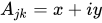

Using the notation to mean the transpose of and an overline to mean the entrywise complex conjugate of a matrix, the Hermitian property is equivalent to the equality

The conjugate transpose of a matrix is often denoted , in terms of which the Hermitian property can be more concisely expressed as . Equivalent notations in common use include , , and , although in quantum mechanics, typically means the complex conjugate only, and not the conjugate transpose.


Hermitian matrices are named after Charles Hermite, who demonstrated in 1855 that matrices of this form share with symmetric real matrices the property of always having real eigenvalues.