Klein–Gordon equation
| Part of a series of articles about |
| Quantum mechanics |
|---|
|
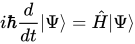
In particle physics, the Klein–Gordon equation is a relativistic wave equation for spinless particles. It was discovered 1926 as the relativistic generalization of the Schrödinger equation, developed independently by numerous authors, among them Oskar Klein and Walter Gordon, after whom it is commonly named. Within relativistic quantum mechanics, it suffers from numerous conceptual problems that are only resolved in quantum field theory, where the equation describes the dynamics of spin-0 fields. Mathematically, it is a linear second-order hyperbolic partial differential equation that is manifestly Lorentz covariant and can be viewed as the wave equation form of the relativistic energy–momentum relation. It plays a fundamental role in many areas of modern physics, such as quantum field theory, particle physics, and cosmology.