In mathematics, the layer cake representation of a non-negative, real-valued measurable function  defined on a measure space
  is the formula
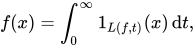
for all  , where
  denotes the indicator function of a subset
  and
and  denotes the (strict) super-level set:

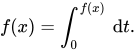
The layer cake representation follows easily from observing that
![{\displaystyle 1_{L(f,t)}(x)=1_{[0,f(x)]}(t)\;\;\;{{\text{or}}\;1_{L(f,t)}(x)=1_{[0,f(x))}(t)}}](./_assets_/eb734a37dd21ce173a46342d1cc64c92/2bf7c5d39c46014cb188451dff966441d89aabeb.svg)
where either integrand gives the same integral:
The layer cake representation takes its name from the representation of the value  as the sum of contributions from the "layers" : "layers"/values
  below contribute to the integral, while values above do not.
It is a generalization of Cavalieri's principle and is also known under this name.
below contribute to the integral, while values above do not.
It is a generalization of Cavalieri's principle and is also known under this name.