Implicit function theorem
| Part of a series of articles about |
| Calculus |
|---|
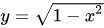
In multivariable calculus, the implicit function theorem is a theorem that provides sufficient conditions under which a planar curve specified by can also be specified as the graph of a function , so that for each point on part of the curve, one has . An example is the unit circle, whose points satisfy , which can locally be solved (if ) by , expressing the top semicircle as a graph. It is not always possible to solve the equation for algebraically, and the implicit function theorem gives analytic conditions under which there exists a function whose graph belongs to the given curve, and, in some formulations, also gives a way of constructing approximations to .





More generally, given a system of m equations fi (x1, ..., xn, y1, ..., ym) = 0, i = 1, ..., m (often abbreviated into F(x, y) = 0), the theorem states that, under a mild condition on the partial derivatives (with respect to each yi ) at a point, the m variables yi are differentiable functions of the xj in some neighbourhood of the point. As these functions generally cannot be expressed in closed form, they are implicitly defined by the equations, and this motivated the name of the theorem.
In other words, under a mild condition on the partial derivatives, the set of zeros of a system of equations is locally the graph of a function.