L'Hôpital's rule
| Part of a series of articles about |
| Calculus |
|---|
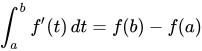
L'Hôpital's rule (/ˌloʊpiːˈtɑːl/ loh-pee-TAHL) is a mathematical theorem used for evaluating the limit of a quotient of two functions, both of which tends to zero or infinity, by taking each function's derivative. The rule is named after the 17th-century French mathematician Guillaume de l'Hôpital, who published it in his 1696 textbook after learning it from his tutor, the Swiss mathematician Johann Bernoulli.
For two functions and , under most circumstances the limit of their quotient can be evaluated as the quotient of the limits: . This is one of the limit laws. However, if both limits tend to zero (that is, ) or if both tend to infinity, this method cannot be applied because the "indeterminate forms" and are not well defined. L'Hôpital's rule states that in such cases (assuming a non-vanishing derivative in the denominator),where and are the derivatives of and .








The differentiation of the numerator and denominator often simplifies the quotient or converts it to a limit that can be directly evaluated by continuity.