Satyendra Nath Bose
Satyendra Nath Bose FRS, MP | |
|---|---|
Bose in 1925 | |
| Born | Satyendra Nath Bose 1 January 1894 Calcutta, Bengal Presidency, British India |
| Died | 4 February 1974 (aged 80) Calcutta, West Bengal, India |
| Education | Presidency College (BSc) Science College, Calcutta University (MSc) |
| Known for |
|
| Spouse | Ushabati Bose (née Ghosh) |
| Awards |
|
| Scientific career | |
| Fields | Theoretical physics, quantum mechanics, mathematics |
| Institutions |
|
Academic advisors |
|
Doctoral students |
|
Other notable students |
|
| Member of Parliament, Rajya Sabha | |
| In office 3 April 1952 – 2 April 1960 | |
| Preceded by | office established |
| Constituency | Nominated (Education) |
| Signature | |
| Part of a series of articles about |
| Quantum mechanics |
|---|
|
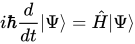
Satyendra Nath Bose (/ˈboʊs/; 1 January 1894 – 4 February 1974) was an Indian theoretical physicist and mathematician. He is best known for his work on quantum mechanics in the early 1920s, in developing the foundation for Bose–Einstein statistics, and the theory of the Bose–Einstein condensate. A Fellow of the Royal Society, he was awarded India's second highest civilian award, the Padma Vibhushan, in 1954 by the Government of India.
The eponymous particles class described by Bose's statistics, bosons, were named by Paul Dirac.
A polymath, he had a wide range of interests in varied fields, including physics, mathematics, chemistry, biology, mineralogy, philosophy, arts, literature, and music. He served on many research and development committees in India after independence.